
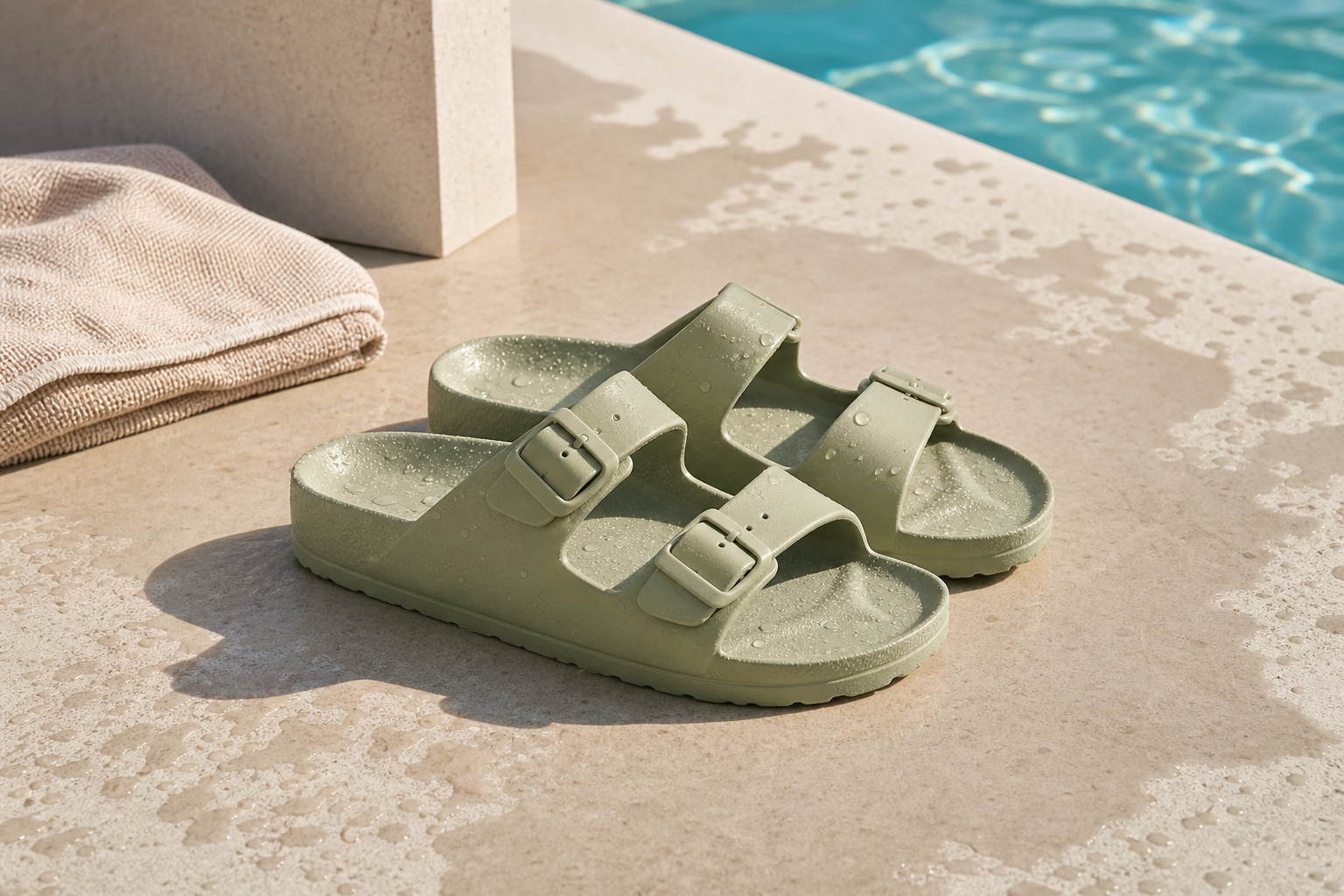
The short answer: choose adjustable EVA sandals when you want to fine-tune the upper around your foot, slides when quick on-and-off wear is the priority, and clogs when you prefer more coverage around the toes. None of these shapes is universally best. The right choice depends on fit, the surface, how much walking you expect, and whether the exact product is intended to get wet.
Compare silhouettes by their shape and intended use. Adjustable uppers, open heels and covered toes change how a shoe fits into a routine; none makes footwear suitable for every surface or activity.
Start with the activity, not the trend
| Situation | Useful starting shape | What to verify |
|---|---|---|
| Pool deck or change room | Water-tolerant sandal or slide | Material, care instructions and facility rules |
| Beach boardwalk | Secure sandal or lightweight clog | Foot retention, distance and surface |
| Quick garden or patio trip | Slide or clog | Coverage, tread condition and fit |
| Longer casual walk | More secure footwear | Heel retention, stability and comfort during a real test |
A poolside shoe does not become slip-proof because it is molded or described as waterproof. Wet tile, sunscreen, sand and worn tread can change traction. Walk carefully, follow posted rules and choose footwear according to the actual environment.
What adjustable EVA sandals change
Two adjustable straps let the wearer alter how the upper sits across the foot. That can be useful when a fixed upper feels too loose or concentrated pressure appears in one area. Adjustment is not the same as a custom fit, however. The heel and toes should remain on the footbed, and the straps should not create numbness, pinching or deep marks.
Use the current product page for the EVA Sandals With Two Adjustable Straps to confirm available sizes, colours, buckle design, material details and care guidance. The title identifies EVA and adjustable straps, but shoppers should not infer medical support, permanent waterproofing or guaranteed traction from those words.
How fixed slides compare
Slides favour convenience. They can be practical when footwear needs to come off quickly, but the open heel and fixed upper mean fit deserves close attention. Walk, stop and turn indoors. If the foot moves sideways, shoots forward or requires constant toe gripping, a different size or a more secure silhouette may be better.
Compare width at the ball of the foot, upper placement and the amount of space ahead of the longest toe. A soft first step may feel pleasant, yet comfort also depends on retention, sole shape, weight and the surfaces where the slide will be worn.
When a lightweight clog may make sense
A clog generally provides more toe coverage than an open sandal while remaining easy to put on. For a damp patio, garden path or casual transition from indoors to outdoors, that extra coverage may appeal to some shoppers. It does not make the shoe suitable for every trail, worksite or water activity.
The Lightweight Slip-On Clogs With Water-Resistant Daily Footwear offer a current comparison point. Review the live listing for exact construction and intended use. Water resistant should not be read as a promise that water can never enter or that the shoe should be submerged.
A fit test that takes five minutes
- Check the current size chart and measure both feet.
- Place the heel and toes fully inside the footbed.
- Adjust straps until secure without concentrated pressure.
- Walk, stop, turn and step over a low threshold indoors.
- Notice sliding, toe gripping, rubbing or instability.
- Confirm the return policy before outdoor wear.
Feet can differ slightly in length or width, and familiar sneaker sizing may not transfer directly to open footwear. Test both shoes. Stop using any pair that causes pain, numbness, broken skin or instability, and seek qualified advice for persistent foot concerns.
Coverage, drainage and drying are different
Coverage describes how much of the foot the upper surrounds. Drainage describes how water can leave a shoe. Drying time depends on material, thickness, airflow and construction. These features should be checked separately. A clog can offer more coverage without being the fastest-drying option; an open slide can expose more of the foot without automatically draining every part of its footbed.
Before using footwear near water, confirm that the manufacturer permits it. Sand, salt and pool chemicals can affect materials and finishes. Rinse only when the care instructions allow it, then air-dry away from intense heat. Do not place molded footwear in a hot car or beside a heater unless the product instructions explicitly permit that treatment.
Compare style without losing practicality
Choose a colour you will wear often, then check whether the shape works with your usual routes and activities. A style that looks appealing still needs to stay comfortably in place.
The Lightweight EVA Sandals With Contoured Footbed provide another two-strap option to compare. Contoured describes the listed shape; it should not be treated as a health claim. Look at the current photos, measurements and specifications before deciding.
Pool and beach safety checks
- Walk rather than run on wet surfaces.
- Use handrails and follow venue footwear rules.
- Check the outsole for embedded grit and visible wear.
- Do not rely on non-slip wording as a guarantee.
- Choose closed or activity-specific footwear where sharp debris or rules require more coverage.
- Apply sun protection to exposed skin according to its label.
Footwear is only one part of a safer environment. Lighting, clear walkways, clean surfaces and appropriate pace also matter. Replace shoes when the sole becomes uneven, cracked or visibly worn.
Frequently asked questions
Are adjustable EVA sandals better than slides?
They offer more upper adjustment, but better depends on fit and use. A well-fitting slide may suit a quick change room visit, while an adjustable sandal may feel more secure for another shopper.
Can EVA sandals be worn in water?
Only use a pair in water when the exact product guidance allows it. EVA in a title does not confirm every buckle, bond or finish is intended for immersion.
Are clogs good for the beach?
They may suit a boardwalk or casual beach transition when fit and material are appropriate. For swimming, rocky shores or water sports, follow activity guidance and consider purpose-built footwear.
How should wet sandals be stored?
Remove grit, follow the care label and let them dry with ventilation away from excessive heat. Store them flat without heavy items deforming the upper.
Bottom line
For a wet-weather outing, compare adjustable EVA sandals, slides and clogs in this order: intended use, secure fit, coverage, material guidance, care and surface. Trends can help narrow the look, but the best purchase is the pair whose current specifications match the way you will actually wear it.